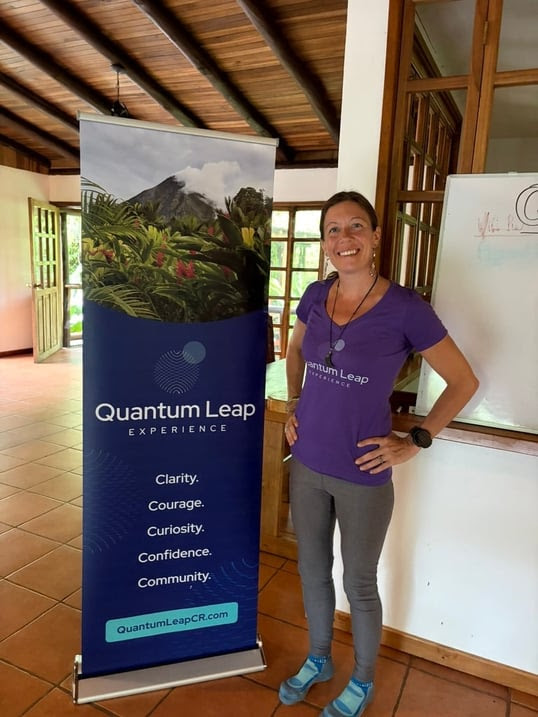
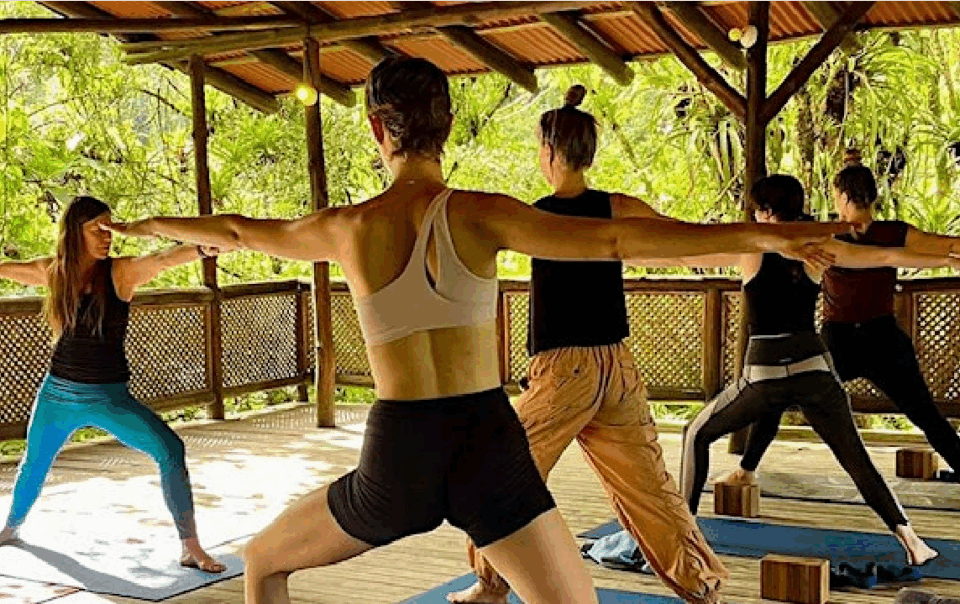
 Hi, I’m Maria, founder of the Quantum Leap Women’s Experience. After a successful career in technology in Atlanta, I relocated to Costa Rica in search of a more intentional, balanced life. Today, I balance helping founders scale companies while encouraging women to reconnect with themselves, trust their inner wisdom, and step confidently into their next chapter.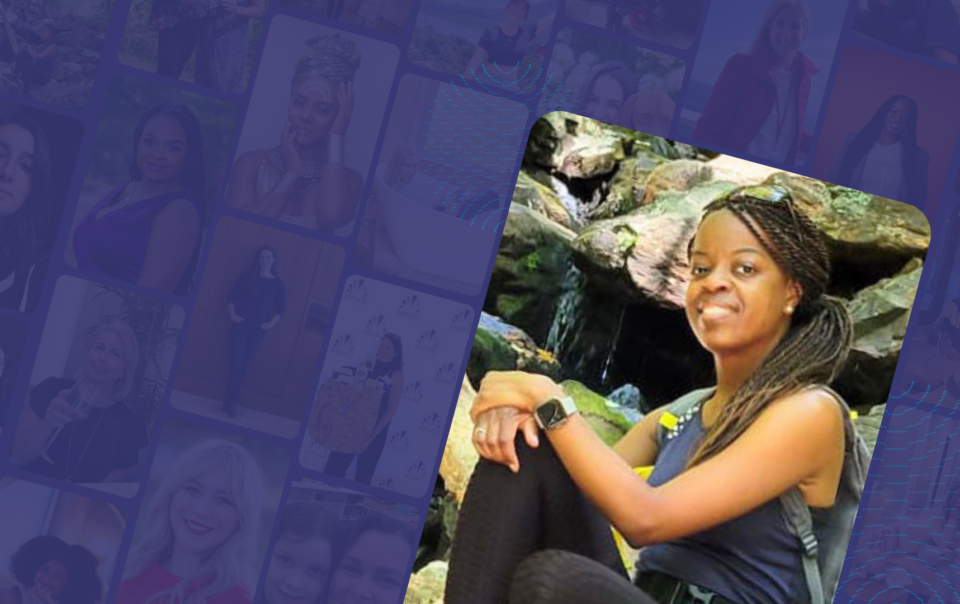


What 200 Miles Taught Me
What if the only way to discover your limits is to push beyond everything you’ve ever done before?
Seven years ago, as I began my ultrarunning journey, I dreamed of one day crossing Costa Rica on foot.
Having lived in Costa Rica for 11 years, I found the idea of traversing the country captivating.
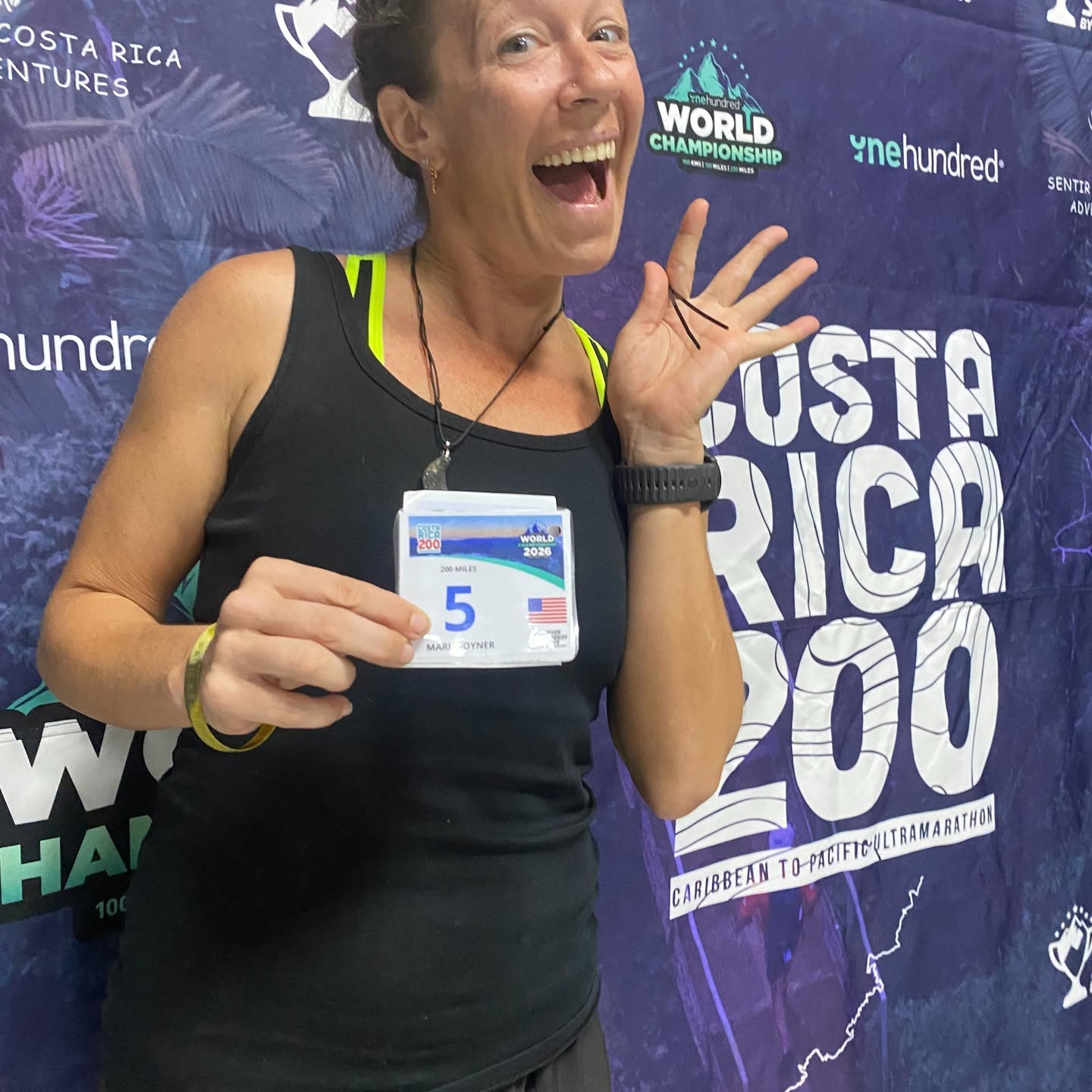
When the Costa Rica 200 premier was announced in 2025, I knew instantly that I had to attempt it the following year.
The Costa Rica 200 is considered one of the hardest 200-mile races in the world. The race crosses the entire country, from the Atlantic Ocean in Limón to the Pacific Ocean in Quepos, through 15 different microclimates. Runners climb from sea level to over 7,500 feet, facing temperatures ranging from 35°F in the highlands to 90°F on the coasts. The course covers more than 208 miles with roughly 50,000 feet of climbing and descending. It’s not just long—it’s relentlessly difficult.
In 2026, I was one of only nine athletes at the starting line. Most were sponsored, full-time professionals. I was a recreational runner who had never tackled anything close to that distance. I felt deeply honored to be among them.
When I committed to running the Costa Rica 200, I had never completed a 200-mile race. I Googled “beginner 200-mile races” and found one in Oregon to use for training. My coach had never guided anyone through a 200-miler either, so we learned together, step by step.
The physical training didn’t change dramatically. Instead of the two-day simulations we use for 100-mile races, we trained for three-day race simulations. What surprised me most wasn’t the running. It was everything else. The amount of gear, food, planning, and packing required to survive five days in the mountains and forests was unlike anything I’d experienced.
The Oregon race became my classroom. I practiced gear choices, nutrition, and sleep strategies, learning how to push through days without rest. But a fast-moving wildfire abruptly canceled the event at mile 135, cutting my lesson short.
So when I stood at the starting line in Costa Rica, I had never run farther than 135 miles or climbed more than 20,000 feet in a single race. It was a privilege to spend time with people who get excited about running 208 miles through jungles, cloud forests, volcanic landscapes, steep mountains, beaches, and every imaginable element.
Committing to the race took a lot of courage. Admittedly, I had a couple of fears.
The first was missing the opening cutoff, which involved running 20 aggressive miles at a sub-12-minute average pace, all in full sun and 95-degree heat.
My second fear was all the unknowns.
Just weeks before the race, I learned I needed two full knee replacements—advanced arthritis, torn meniscuses, and no remaining cartilage. My doctor warned me that running downhill would be the worst thing for me.
Costa Rica 200 includes nearly 50,000 feet of descent.
My body had never endured anything remotely close. How would I respond? Would my knees even hold up?
Thankfully, neither fear materialized.
I trained hard and made the first cutoff. Thankfully, my knees never became an issue. I paced myself conservatively until the final day, when it was time to push.
Instead, something completely unexpected became my limiting factor. My back.
For four days, I drew on every ultrarunning skill I had: technical trails, steep climbs, relentless descents, beach running, heat and humidity, cold mountain mornings, and endless hours alone.
I spent multiple nights by myself in the jungle. Some nights I didn’t sleep at all. Others, I slept only a couple of hours.
More than half of the hundreds of thousands of steps I took were marked by painful blisters and chafing.
But mentally? I was exactly where I wanted to be. I controlled my mind. I was happy. I was at peace.
My goal from the start was simple: either cross the finish line or discover the true limits of my physical body.
For the first time, I reached that limit.
At mile 191, after nearly 48,000 feet of elevation change, I made the decision to stop. Only 18 miles remained, but my back simply could not continue.
Strangely, it didn’t feel like failure. It felt like clarity-a hard-won understanding of my limits.
This was a life-changing experience.
I fell in love with Costa Rica all over again. Despite living here for 11 years, I had never seen most of the race course. The landscapes were breathtaking. The people were incredible. I stopped at farms high in the mountains, asking strangers to refill my water bottles, and everywhere I went, people greeted me with kindness.
I’m equally grateful for the volunteers who greeted us with smiles at aid stations—sometimes 20 miles apart—and for the medical team who cared tirelessly for our battered feet.
This race wasn’t just an endurance event.
It reminded me that our limits are often far beyond what we imagine, and that success isn’t measured solely by reaching the finish line. Sometimes it’s measured by your willingness to discover where your true limits lie.
I fought harder than I ever have, and I’m incredibly proud of how far I got.
Now I get a full year to prepare for the challenge once again. And I can’t wait to race the Costa Rica 200 again in 2027.
|
|